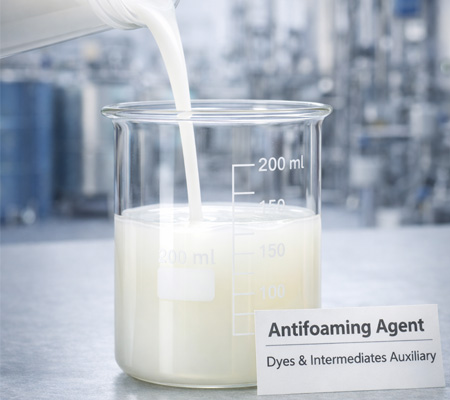
An Antifoaming Agent (also known as defoaming agents) is a process chemical used to control foam in industrial liquids and reaction systems. In many manufacturing operations, an anti-foaming agent is a chemical additive that reduces and hinders the formation of foam in industrial process liquids, helping maintain stable flow, consistent processing, and better product quality.
As a producer, manufacturer and supplier, Aahan Chemiex LLP supplies antifoaming agent solutions engineered to prevent foam formation and deliver reliable knockdown performance across demanding process conditions.
An antifoaming agent is a chemical additive used to prevent foam from forming or to break down foam once it appears. It is commonly used where agitation, pumping, aeration, or chemical reactions create persistent foam that disrupts production.
Many antifoaming agent formulations are based on compounds such as:
Selection depends on the process liquid, temperature, pH, and product sensitivity.
Foam forms when air is trapped in a liquid and stabilized by surfactants or reaction by-products. Antifoams help control this behavior.
In simple terms:
This makes antifoaming agents important in processes where foam causes overflow, poor mixing, reduced effective volume, or defects in the final product.
Controls foam for stable and consistent processing.
Helps avoid overflow and foam-related pump problems.
Reduces stoppages caused by excessive foam formation.
Minimizes air entrapment and surface defect risks.
Works across various industrial liquid process systems.
Supports fast knockdown with controlled chemical dosing.
In dye and intermediate production, foaming can occur due to agitation and surfactant-like materials. Antifoaming agents help stabilize reactions, reduce foam during mixing, and improve plant efficiency.
Used in reactors and mixing tanks where foam disrupts effective volume and reaction control. Antifoams help maintain stable process conditions and reduce product loss
In systems where foam impacts feed stability or processing, antifoams help reduce foam before drying and improve process stability.
Foaming in effluent tanks can cause operational issues. Antifoaming agents help maintain smooth operation in industrial wastewater processes (grade dependent).
Antifoaming agents are used across:
Dyes intermediates and specialty chemical plants
Textile chemical processing units
Paper and pulp processing
Detergent and home care manufacturing
Industrial wastewater and effluent treatment systems
General chemical manufacturing and blending units
As a producer, manufacturer and supplier, Aahan Chemiex LLP supports customers with:
As a leading manufacturer, Aahan Chemiex LLP provides Antifoaming Agents specifically formulated to provide rapid foam knockdown and long-lasting persistence in both aqueous and non-aqueous systems.
Based in the industrial hub of Ahmedabad, Gujarat, we operate as a reliable exporter, ensuring our precision-manufactured Antifoaming Agents meet the rigorous standards of international buyers.
It is used to prevent or reduce foam formation in industrial process liquids, improving process stability and reducing foam-related losses.
Yes. Antifoaming agents are also known as defoaming agents. Antifoam focuses on prevention and defoamer focuses on knockdown, but in practice many products provide both effects.
They are commonly formulated using silicone, glycol, or fatty alcohol compounds, depending on process requirements and compatibility needs.
It works by reducing surface tension and foam film elasticity, destabilizing bubbles and preventing stable foam formation.
They are used in mixing, reaction, transfer, and processing stages where foam formation disrupts operations or affects product quality.
If selected correctly and dosed properly, it controls foam without negative impact. Compatibility depends on product system, so grade selection is important.
Share your process liquid type, temperature, pH, agitation level, and foam severity. This helps select the correct chemistry (silicone/glycol/oil-based) and dosing method.
Aahan Chemiex LLP works as a producer, manufacturer and supplier of antifoaming agents for dyes, intermediates, and industrial process applications.
Share your process stage, foam issue, and operating conditions. Our team will recommend the suitable antifoaming chemistry and practical dosing guidance for consistent, low-foam operation.