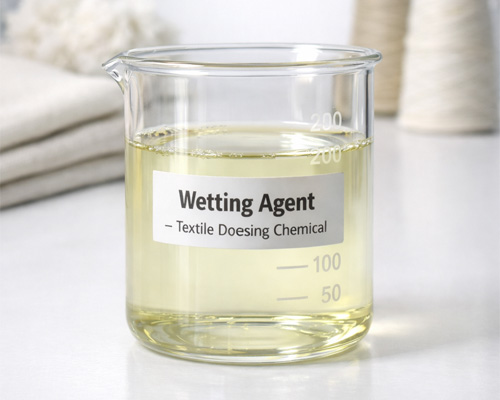
A Wetting Agent is a key textile auxiliary used to improve how quickly and evenly water-based baths wet the fabric. It is a surface-active agent that reduces water’s surface tension, enabling rapid and uniform penetration of liquids like dyes, finishes, and process chemicals into fibers.
As a producer, manufacturer, supplier and dealer of textile auxiliaries, Aahan Chemiex LLP provides wetting agent grades designed for quick, uniform, and deep penetration of dyes and chemicals across different fabric types and processing stages.
A wetting agent is a chemical that improves the contact between a liquid and a solid surface. In textile processing, it is used to help the liquor spread and penetrate inside yarns and fabric structures quickly. Because it lowers surface tension, the bath enters the fiber structure faster and more evenly, reducing common wet-processing issues.
In simple words:
Many textile problems start with poor wetting, such as:
A well-selected wetting agent helps improve the efficiency and effectiveness of dyeing, printing, and finishing operations by ensuring the fabric is evenly wetted from the start.
Reduces water surface tension for faster wetting.
Enables quick and deep penetration of dyes.
Improves initial bath contact for even dyeing.
Improves scouring and washing by proper wetting.
Helps prevent spots, patchiness, and uneven results.
Reduces wetting time and improves bath action.
Wetting agents help wet the fabric quickly so pretreatment chemicals work evenly. This improves absorbency and prepares the fabric for dyeing and finishing.
During dyeing, wetting agents support faster liquor penetration into the fabric and yarn, reducing uneven dye uptake and improving shade consistency, especially in difficult constructions.
Wetting agents are used to improve spreading and penetration of printing pastes, helping reduce uneven print appearance and improving clarity (process and formulation dependent).
In finishing, wetting agents help finishes distribute evenly on fabric, supporting consistent hand-feel and performance across the full fabric width.
Wetting agents are widely used in:
Textile dyeing and finishing houses
Knitting and weaving mills
Garment dyeing and garment washing units
Home textile manufacturers
Textile printing units
Export oriented textile units
The right wetting agent depends on:
Aahan Chemiex LLP supports grade selection based on your process route and performance needs.
As a leading manufacturer, Aahan Chemiex LLP provides Wetting Agents that significantly reduce surface tension, allowing for rapid and uniform penetration of processing liquors into textile fibers.
Strategically based in the industrial hub of Ahmedabad, Gujarat, we operate as a reliable exporter, delivering precision-manufactured Wetting Agents to global textile markets.
A wetting agent reduces water’s surface tension and helps the bath penetrate quickly and evenly into fibers, improving overall wet processing performance.
Yes. A wetting agent is a surface active agent that lowers surface tension and improves spreading and penetration of liquids.
Fast and uniform wetting improves initial dye bath contact and supports more consistent dye uptake, reducing patchiness and uneven shades.
Yes. Wetting agents are used to improve the spreading and penetration of liquids and can help improve the efficiency and effectiveness of dyeing, printing, and finishing operations.
Foam depends on the chemistry and grade. Low-foam wetting agent grades are available for machines where foam control is required.
They are used in desizing, scouring, washing, and sometimes bleaching support routes to ensure uniform wetting and better chemical action.
Share fabric type, stage of process, machine type, temperature, and foaming limitations. This helps select the correct grade.
Yes. Aahan Chemiex LLP works as a producer, manufacturer, supplier and dealer of wetting agents and other textile auxiliaries for industrial textile processing needs.
Share your fabric type and process stage. Our team will recommend the suitable grade to support quick, uniform, and deep penetration of dyes and chemicals with stable performance in your production line.