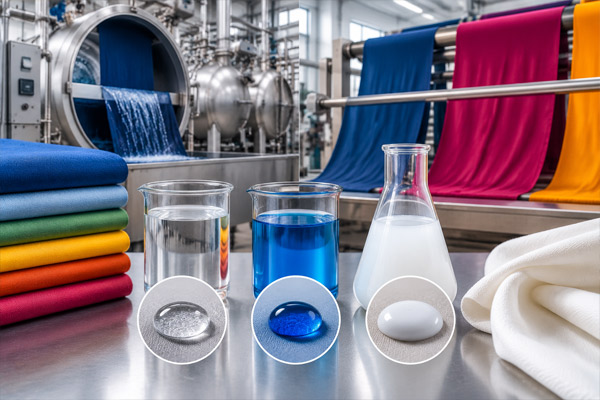
Textile mills, dyeing houses and garment processors face a common challenge: achieving perfect color uniformity, fast fabric wetting and desired hand feel in finished products. The secret lies in selecting the right textile chemicals.
Three key auxiliaries drive quality results: a levelling agent supplier’s product controls dye absorption, a wetting agent speeds liquid movement, and silicone emulsion provides softness. This guide explains how to choose these three chemicals based on your fabric type, dye class and production process.
Whether you operate a small dyeing house or a large textile mill in India, understanding these chemicals saves money and improves product consistency. This article walks you through each chemical’s function, when to use it, and how to pick the best option for your specific needs.
A levelling agent is a chemical auxiliary that prevents uneven dye absorption during the dyeing process. It works by slowing down the dye uptake speed, allowing color to spread evenly across all fibers before fixing permanently.
Without a levelling agent, dyes absorb too quickly into fabric surface areas, leaving darker patches and lighter zones. This creates visible color variation, called “unlevelled” fabric—a major quality defect.
Levelling agents are added to the dye bath before or at the start of the dyeing cycle. They remain active throughout the heating and cooling process, continuously working to maintain even dye distribution.
When choosing a levelling agent supplier, consider:
Function in Textile Processing
A wetting agent is a surfactant chemical that reduces water’s surface tension, allowing liquids to penetrate textile fibers quickly and completely. It acts like a “bridge” between water and fabric, making liquids sink in instead of sitting on the surface.
Without proper wetting, fabrics develop dry patches, creases and uneven moisture distribution. This ruins dyeing quality and causes processing delays.
Processing Stage
Wetting agents are used at the very start of dyeing, before adding dyes or other chemicals. They are also applied during fabric preparation, scouring and washing stages to speed up liquid absorption.
Key Benefits
Selection Criteria for Wetting Agents
A good wetting agent in India should match:
Function in Textile Finishing
A silicone emulsion is a water-based suspension of silicone oil that coats fabric fibers, adding a smooth, soft and slippery surface. It improves the fabric’s “hand feel”—how it looks and feels when touched.
Silicone emulsions do not affect fabric color or dye uptake. They work only during the finishing stage, after dyeing is complete.
Processing Stage
Silicone emulsions are applied in the final finishing process, usually after dyeing and washing. The fabric passes through a bath containing diluted silicone emulsion, allowing the coating to settle on fiber surfaces.
Key Benefits
Selection Criteria for Silicone Emulsions
When choosing a silicone emulsion in India, evaluate:
| Feature | Levelling Agent | Wetting Agent | Silicone Emulsion |
|---|---|---|---|
| Primary Function | Controls dye absorption | Speeds liquid penetration | Adds softness and smoothness |
| Processing Stage | During dyeing (mid-process) | Before dyeing (start) | After dyeing (finishing) |
| Main Benefit | Uniform color | Fast processing | Better hand feel |
| Affects Dye Quality? | Yes, directly | Yes, affects dye pickup | No, cosmetic only |
| Water-Based? | Yes, usually | Yes, typically | Yes, water-based suspension |
| Typical Dosage Range | Varies by type | Varies by type | Varies by type |
| Removable? | No, fixes with dye | No, remains in fiber | Partially in washing |
| Best for | All fiber types | All stages | Premium finished fabrics |
If uneven dye uptake is the problem: You need a suitable levelling agent. Symptoms include dark streaks, light patches or color variation across the fabric width. Different dye classes and fiber types require different levelling agents.
If slow liquid penetration is the problem: You need a suitable wetting agent. Symptoms include dry patches, water marks, creases that won’t wash out, or processing delays. Textile wetting agent suppliers offer products designed for your machine type and fiber.
If fabric softness is required: You need an appropriate silicone emulsion. This applies when customers demand premium hand feel, improved drape or enhanced garment comfort.
A levelling agent manufacturer in India should provide:
Based in Ahmedabad, Gujarat, Aahan Chemiex LLP specializes in textile auxiliaries manufacturer serving dyeing mills, garment processors and chemical distributors across India.
As a dedicated levelling agent manufacturer in India, we understand the unique challenges of Indian textile production:
Our range includes levelling agents for reactive dyes, acid dyes and disperse dyes; wetting agents for all machine types; and silicone emulsions for premium finishing. As a textile chemicals supplier in Gujarat, we maintain strict quality control and provide trial samples for testing.
Before Placing Your Order
During Implementation
Quality Assurance
Always source from established manufacturers. When you buy levelling agent in bulk, demand:
A reliable bulk textile chemicals supplier stands behind their products and supports your mill’s success.
Sometimes you need to change your current chemical choice:
Consult your supplier before making changes. Small adjustments in chemical choice can significantly impact results.
A levelling agent controls how fast dyes absorb into fabric during dyeing, preventing uneven color. A wetting agent helps water and other liquids penetrate fibers quickly before dyeing starts. Levelling agents work throughout the dye cycle; wetting agents work at the beginning. Both are essential for quality results.
Some wetting agents work for both, but not all. Cotton and polyester require different surfactants because they absorb liquids differently. Check with your supplier about which wetting agent suits your specific fiber blend. Using the wrong type can delay processing and create quality problems.
Good dyeing and good hand feel are separate things. Silicone emulsion adds softness and smoothness that dyeing alone does not provide. If customers demand premium feel, soft drape or water resistance, you need silicone emulsion. For basic fabrics, it may not be necessary.
Only change if your current supplier fails on quality, delivery, price or service. Switching mid-production can be risky because different manufacturers’ products behave differently. If you must change, request trial samples and test thoroughly before large-scale orders.
Dosage depends on fiber type, fabric weight, machine type and water quality. Do not guess or copy other mills’ doses. Contact your wetting agent supplier for recommended ranges based on your specific conditions. Incorrect dosage wastes chemicals and ruins fabric quality.
No. Silicone emulsion is applied after dyeing and does not interact with dyes. However, it should be applied correctly to avoid uneven coating, which might create appearance issues. Follow manufacturer instructions for dilution and application.
Yes, absolutely. Reactive dyes, acid dyes and disperse dyes are absorbed differently by fibers. Each dye class works best with specific levelling agents. Consult your levelling agent supplier about the correct product for your dye class.
Store in cool, dry conditions away from direct sunlight. Keep containers sealed to prevent contamination or evaporation. Check expiration dates before use. Poor storage reduces chemical effectiveness and wastes money. Store silicone emulsions separately from aqueous chemicals.
Too much levelling agent slows dye uptake excessively, requiring longer heating times and higher temperatures. This wastes energy and can damage fiber. Under-dyed fabric may result, requiring re-processing. Always follow supplier dosage recommendations.
Some combinations work well; others cause problems. Always consult your chemical supplier before mixing products. Different manufacturers’ formulations may not be compatible. Mixing without guidance can damage fabric and waste chemicals.