
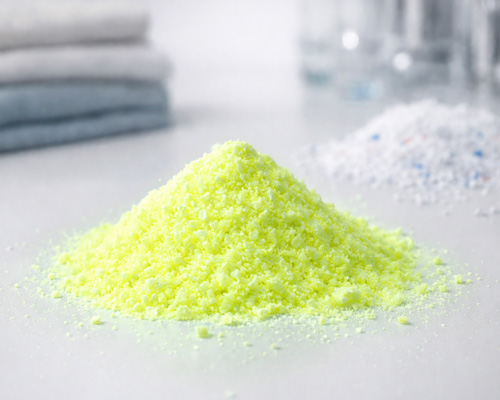
An Optical Brightening Agent is a specialty chemical used to improve the visual whiteness and brightness of fabrics. These materials are also known as Optical Brightening Agents (OBAs) or Fluorescent Brightening Agents (FBAs). In simple terms, brightening agents are organic compounds that absorb ultraviolet radiation and then “absorb light in one region of the spectrum and re-emit that light in another region” as visible blue light.
This optical effect reduces the appearance of yellow tones and makes textiles look cleaner, whiter, and brighter.
Optical Brightening Agents (OBAs) are fluorescent molecules that deposit on or interact with textile fibers. When exposed to daylight or UV-containing light sources, the OBA produces a visible fluorescence that increases brightness and improves the “white” appearance of the fabric.
This is why OBAs are widely used for:
The working principle is optical, not bleaching.
Improves fabric whiteness and brightness without harsh bleaching.
Helps remove yellow tones from white textiles.
Enhances the overall look and quality of fabrics.
Maintains uniform whiteness in white and pastel fabrics.
Works well in textile dyeing and finishing processes.
Helps maintain long-lasting whiteness in fabrics.
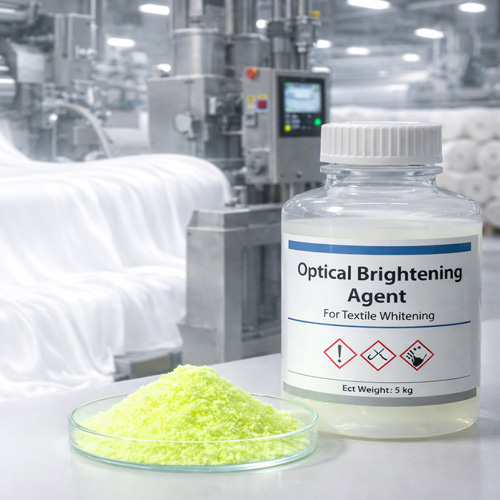
Optical Brightening Agents are commonly:
Common textile segments where OBAs are used
Note: The right OBA grade depends on fiber type, process route, and desired whiteness tone (neutral, bluish, etc.).
Optical Brightening Agents (OBAs/FBAs) are used by:
Textile processing houses
Knitting and weaving mills
Garment processing and garment washing units
Home textile manufacturers
Laundry and detergent manufacturers
Selection depends on:
Aahan Chemiex LLP supports customers by recommending the right OBA grade for their textile route and end-use expectation. With a robust supply chain, we serve as a reliable exporter, ensuring our specialized chemicals reach global markets with zero compromise on quality.
Optical brighteners are widely used across industries. For example, they are prominently featured in laundry detergents because they help fabrics look brighter after washing. Textile-grade OBAs and detergent-grade OBAs may differ by formulation and performance requirements, but the optical principle remains the same.
An Optical Brightening Agent is used to increase the visible whiteness and brightness of fabrics, reducing yellow tones and improving fabric appearance.
Yes. Optical Brightening Agents (OBAs) are commonly referred to as Fluorescent Brightening Agents (FBAs) because they work by fluorescence under UV or daylight.
No. Brightening is an optical effect. Brightening agents are organic compounds that absorb ultraviolet radiation and re-emit visible light to make fabrics appear whiter.
They are widely used in the dyeing and finishing of textiles, including exhaust and padding applications, especially for whites and light shades.
They are prominently featured in laundry detergents because they help washed fabrics look brighter by adding an optical whitening effect after wash cycles.
Yes, but the OBA chemistry and grade selection matters. Different OBAs work best on different fibers and process routes.
OBAs can influence the perceived whiteness tone under different lighting conditions. Using the right grade and controlled dosage helps maintain consistent results.
When used correctly in industrial processes and within recommended dosage ranges, OBAs are commonly used across textile and detergent industries. Always follow handling and process guidelines.
Share your fiber type, process route, application method, and target whiteness tone. This helps select the most suitable Optical Brightening Agent.
Share your fabric type and process details, and our team will recommend the right grade and usage guidance for consistent whiteness and brightness.