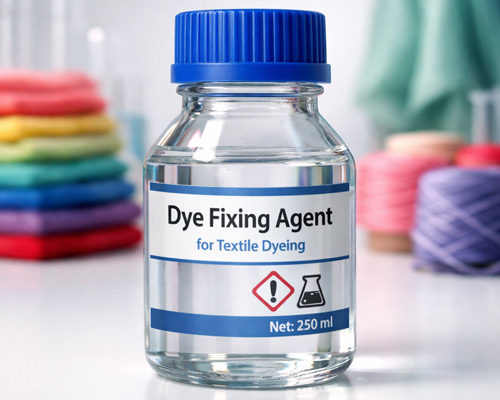
A Dye Fixing Agent is a textile auxiliary used after dyeing to improve how well dye stays on the fabric during use and washing. Dye fixing agents are chemicals incorporated into textile finishing processes to enhance the color fastness of dyed fabrics, especially for direct dyes and reactive dyes on cellulosic fibers like cotton and viscose.
These products are also called Dye Fixatives or fixing agent for dyed fabric because they help reduce color bleeding and improve shade stability.
A dye fixing agent is typically a specialized chemical system designed to strengthen the bond between dye molecules and fiber. In many cases, the product is based on polymeric fixers that form a thin protective network on the fiber surface and lock dye inside the fabric structure. Some dyeing routes also use process chemicals such as soda ash to support dye fixation during reactive dyeing, but a Dye Fixative used after dyeing is usually selected to improve final fastness performance.
A well-designed dye fixing agent supports:
Dye fixatives work by improving dye-fiber interaction and controlling loose dye that can migrate out during wet use. Depending on the dye class and fabric, a fixative can:
This is why dye fixing agents are chemicals incorporated into textile finishing processes to enhance the color fastness of dyed fabrics in dyehouses and garment processing units.
Modern dyehouses increasingly prefer non-formaldehyde dye fixing agents due to safety, compliance, and end-customer requirements. In many applications, non-formaldehyde dye fixing agents improve the color fastness of direct and reactive dyes, enhancing resistance to soaking, washing, perspiration, and wet rubbing when used with correct process settings and dosage.
These are commonly selected for:
Depending on the fabric and dye system, dyehouses may use:
Choosing the correct fixer depends on dye type, shade depth, fabric structure, and required fastness standard.
A dye fixing agent is usually applied after dyeing and washing-off, as part of finishing. It is widely used for:
Used in cotton and viscose dyeing to reduce bleeding and improve wash fastness, especially for reactive and direct dye shades.
After proper dyeing with salt/soda ash route, a dye fixative can improve final fastness results and help stabilize deeper shades.
Direct dyes can be more prone to bleeding. Dye fixatives help improve resistance to wet conditions, making them more suitable for garments and home textiles.
Helps improve fastness after garment dyeing, especially where repeated washing and rubbing performance is important.
Widely used where wet rubbing issues are reported and the buyer requires improved fastness standards.
Dye fixing agents are commonly used by:
Textile dyeing and finishing houses
Knitting and weaving mills
Garment manufacturing and garment dyeing units
Home textile manufacturers
Home textile producers
Export-oriented textile units
The exact dye-fixing agent composition depends on the product grade and dye system. Many commonly used fixatives are based on:
For best results, composition selection must match the dye class and process route.
To get consistent results with a dye fixing agent:
Fixation also supports better dye absorption control by minimizing loose dye migration after dyeing, improving perceived shade stability.
A Dye Fixing Agent is used to improve color fastness by reducing bleeding and improving resistance to washing, soaking, perspiration, and wet rubbing.
Yes. Dye Fixatives are commonly used for reactive dyeing to improve final wet fastness, especially in medium to dark shades after proper washing-off.
Non-formaldehyde dye fixing agents improve the color fastness of direct and reactive dyes, enhancing resistance to soaking, washing, perspiration, and wet rubbing, while supporting compliance needs.
Soda ash is mainly used during reactive dyeing to support dye fixation in the dye bath. Polymeric fixers are usually used after dyeing as dye fixatives to improve fastness and reduce bleeding.
A Polyamide Dye Fixing Agent is a fixer grade used for certain dye-fiber systems to improve fastness performance. Grade selection depends on dye class and fabric type.
Some fixatives can cause slight shade change if dosage is high or the grade is not suitable. Correct selection and optimized dosage help maintain shade quality.
Yes, dye fixing agents are commonly used to improve wet rubbing fastness by reducing dye migration in wet conditions.
Usually after dyeing and proper washing-off. It can be applied through exhaust method in a dyeing machine or via padding, depending on the line setup.
Share fabric type, dye class (reactive/direct), shade depth, process route, and the fastness issues you face (washing, rubbing, perspiration). This helps select the most suitable dye fixative grade.
Share your fabric type, dye class, shade depth, and target fastness standard. Our team will recommend the right grade with practical application guidance for stable results.