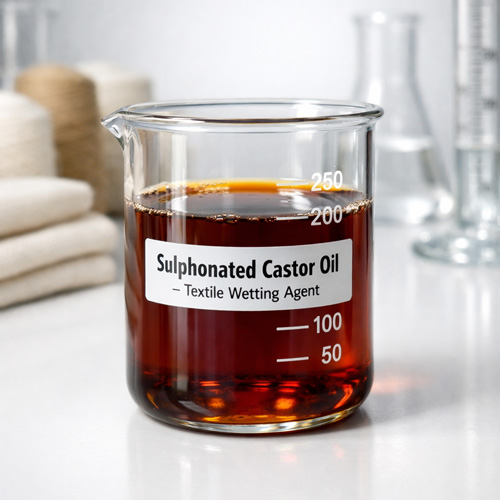
Sulphonated Castor Oil, also called Sulphated castor oil or Turkey red oil, is a widely used textile auxiliary known for its strong wetting, emulsifying, and dispersing performance. In textile processing, it functions as an anionic surfactant, helping water-based baths penetrate fabric faster and assisting in the removal of oils, waxes, and impurities during preparation. It is produced by a controlled reaction where sulphuric acid is added to vegetable oils, most notably castor oil. In practical terms, it supports cleaner processing, improved bath stability, and more uniform results across fabric lots.
Note for accuracy: In many textile operations, Turkey red oil is primarily used as a wetting and emulsifying agent (and sometimes as a lubricant/levelling support). It is not typically categorized as a primary antifoaming agent, although it can influence foam behavior depending on the formulation and process.
Sulphonated Castor Oil is a modified castor oil made by treating castor oil with sulphuric acid, which introduces sulphonate/sulphate groups and makes the oil water-dispersible. Because it behaves as an anionic surfactant, it helps oil and water mix, stabilizes emulsions, and improves wetting in aqueous processing baths.
This chemistry is historically significant because sulphated/sulphonated oils are often described as early industrial surfactants, and Turkey red oil is sometimes referenced as one of the earliest “synthetic detergent” style agents used in industrial cleaning and textile wetting.
Helps water and chemicals penetrate fibers more quickly
Helps emulsify oils, waxes, and lubricants for better removal
Assists in preparation baths for cleaner fabric surfaces
Supports stable processing in wet operations
Helps reduce patchiness by improving wetting and dispersion
Useful across many cotton and blended fabric routes (grade dependent)
Sulphonated Castor Oil is used across multiple wet-processing steps, especially where wetting and emulsification are required.
During desizing, scouring, and washing, Turkey red oil improves fabric wetting and helps remove oily impurities and processing lubricants. This leads to better absorbency and more consistent downstream dyeing.
In textile baths, it helps emulsify spinning oils, knitting oils, and wax residues, allowing them to be carried away in washing-off. This supports cleaner fabric surface and reduces defects.
As an anionic surfactant, it can support dispersion and wetting in dye baths, helping achieve more uniform dyeing by reducing surface tension and improving bath contact.
In some operations, it is used to improve wetting and spread, helping chemicals distribute more evenly on the fabric surface.
Sulphonated Castor Oil is widely used by:
Textile dyeing and processing houses
Knitting and weaving mills
Garment processing and washing units
Home textile producers
Textile chemical formulators
If fabric is not properly wetted or if oils are not emulsified and removed, common problems appear:
Using the correct grade and dosage of Sulphonated Castor Oil (Turkey red oil) helps stabilize processing and improve overall consistency.
Sulphonated Castor Oil is commonly known as Turkey red oil and is also referred to as sulphated castor oil in many markets.
Yes. Turkey red oil behaves as an anionic surfactant, making it useful for wetting, emulsifying, and dispersing in water-based textile baths.
It is made by adding sulphuric acid to vegetable oils, most notably castor oil, to create a water-dispersible surfactant-type product.
Its primary use is as a wetting and emulsifying agent, supporting pre-treatment, scouring, washing, and improving bath penetration on fabrics.
It is not typically used as a primary antifoaming agent. In most textile applications, it is mainly used for wetting and emulsification. Foam behavior can vary by process and formulation.
It is commonly used in desizing, scouring, washing-off, dyeing support baths, and in processes where oil removal and wetting are important.
Yes. By improving wetting and dispersion, it can support more uniform dye bath contact, which helps reduce patchiness and improves dye uptake consistency.
It is widely used for cotton and cotton blends, and also in various wet-processing routes where emulsification and wetting are required. Final selection depends on the fabric and process.
Share fabric type, process stage (scouring/dyeing/washing), water hardness, and the problem you want to solve (oil removal, wetting speed, bath stability). This helps choose the best grade and dosage.
Share your fabric type and process stage, and our team will recommend the suitable grade with practical usage guidance for consistent results.