
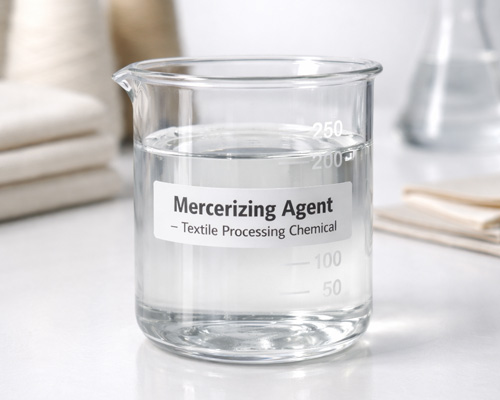
A Mercerizing Agent is a specially formulated textile auxiliary used to improve the effectiveness of the mercerization process in cotton. Mercerizing Agent is a specially formulated chemical that enhances the mercerization process by improving wetting and penetration of the caustic soda solutions during cotton textile treatment.
In most systems, it works as a Wetting Agent made from specialized anionic wetting agents that remain stable in strong alkali. The result is better, more uniform mercerization, which supports higher fabric quality and consistent finishing.
Mercerization is a key step in textile pretreatment where cotton fabric is treated with concentrated caustic soda under controlled conditions to improve fiber properties. A mercerizing agent is added to help the caustic soda bath wet the fabric quickly and evenly, so the alkali reaches fiber surfaces uniformly.
A high-performance Mercerizing Agent is:
Because of these properties, it is commonly considered a specialized wetting agent for mercerization.
In mercerization, uneven wetting can lead to:
Using the right Mercerizing Wetting Agent supports consistent treatment and reduces defects caused by poor penetration or trapped air.
Provides fast wetting and deep penetration in caustic soda baths.
Ensures uniform mercerization across fabric width and length.
Enhances fabric strength and improves natural luster.
Improves absorbency and supports consistent dyeing results.
Remains stable in strong alkaline processing environments.
Helps reduce streaks, spots, and uneven fabric patches.
Mercerizing agents are mainly used in cotton textile treatment, especially where concentrated alkali is used.
Added to caustic soda solutions during cotton textile treatment to improve fabric wetting and alkali penetration. This supports consistent mercerization, leading to better luster, improved strength, and uniform performance in later stages.
Used as part of textile pretreatment to support smooth wetting, reduce air entrapment, and improve chemical bath contact on fabric surfaces.
Mercerization is often considered a finishing-related enhancement step for cotton, and a mercerizing agent helps achieve a premium look and feel by improving the process consistency and fabric brightness perception.
Textile dyeing and finishing houses
Cotton fabric manufacturers
Garment processing units
Home textile producers
Export-oriented textile units
Selection depends on:
A well-matched mercerizing agent is usually anionic, stable in alkali, and designed for reliable wetting with minimal process disturbance.
A Mercerizing Agent is used to improve wetting and penetration during mercerization, helping caustic soda solutions treat cotton more evenly for better luster and strength.
It is a specialized Wetting Agent designed specifically for mercerization conditions. It typically contains specialized anionic wetting agents and is stable in concentrated alkaline baths.
Mercerization uses strong caustic soda. A Mercerizing Agent is usually anionic and highly stable in concentrated alkaline baths, so it can perform consistently without breaking down.
Mercerization can increase cotton fiber strength and improve luster. A mercerizing agent helps the process happen uniformly, supporting consistent strength and glow across the fabric.
Yes. By improving wetting and reducing air entrapment, a good mercerizing wetting agent helps reduce uneven mercerization, streaks, and patchy luster.
It is primarily used for cotton and cotton-rich fabrics where mercerization is applied. Final suitability depends on fabric construction and process route.
It is added to the caustic soda bath or dosing system in the mercerizing line, depending on the machine and process setup.
Share fabric type, machine type, caustic concentration, temperature, and production speed. This helps select the most suitable high-performance Mercerizing Agent.
Share your fabric type, mercerizing line details, and caustic concentration. Our team will recommend the right specialized anionic wetting agent grade with practical usage guidance for consistent mercerization results.