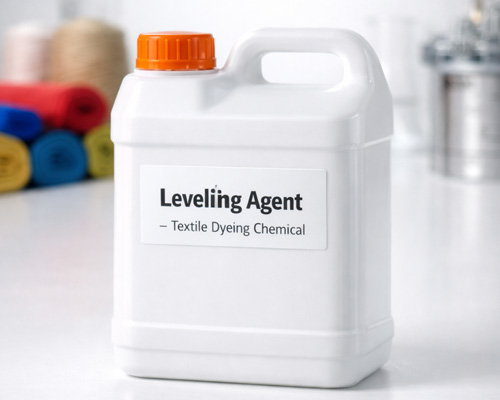
A Levelling Agent is one of the essential textile auxiliaries (surfactants or polymers) used in dyeing to achieve smooth, even, and repeatable shades. In practical dyehouse work, leveling agents are added to improve the evenness and consistency of dye or pigment uptake on fabric.
They support controlled dye movement and help correct shade variations by encouraging the movement of dyes from areas of high concentration to low concentration, correcting unevenness during dyeing.
Levelling agents used in textile dyeing are chemical auxiliaries that control the rate of dye absorption and promote balanced dye distribution on the fiber. They can be surfactant-based, polymer-based, or blended systems designed for specific dye classes and fiber types.
A good leveling agent helps:
Because different fibers and dyes behave differently, levelling agents are selected based on the dye class (reactive, disperse, acid, direct) and fiber type (cotton, polyester, nylon, blends).
During dyeing, dye tends to absorb faster in some areas than others due to fabric construction, temperature differences, liquor flow, or local concentration. Levelling agents help manage this by:
In many processes, leveling agents also help in fixing the dye particles uniformly by improving bath stability and controlled dye absorption behavior.
Improves even dye and pigment uptake on fabrics.
Minimizes streaks, spots, and uneven dye patches.
Supports better dye migration for smooth shade build.
Helps maintain batch-to-batch shade consistency.
Improves dyeing on difficult fabrics and shades.
Helps reduce rework, correction cost, and waste.
Levelling agents help control dye strike and improve uniformity, especially for medium and dark shades where uneven absorption becomes visible. They support stable dyeing and better shade reproducibility.
Levelling agents promote uniform dye absorption on natural and synthetic fibers, especially in high-sensitivity processes such as polyester dyeing. Polyester dyeing is sensitive due to temperature rise, disperse dye dispersion quality, and fabric construction differences. Levelling agents:
In synthetic dyeing routes, levelling agents support controlled uptake and reduce dyeing faults, especially in blends where different fibers absorb dye at different rates.
For pigment systems, certain leveling auxiliaries help improve distribution and reduce uneven appearance by stabilizing the bath or dispersion and improving wetting.
Textile dyeing houses
Knitting and weaving mills
Garment dyeing and garment processing units
Home textile manufacturers
Export-oriented textile units
Not all leveling agents work the same. Selection depends on:
Correct selection ensures the agent supports dye uniformity without causing foam, shade dullness, or other side effects.
A levelling agent is used to improve shade evenness by controlling dye absorption and helping dyes distribute uniformly on fabric.
Yes. Levelling agents are among essential textile auxiliaries and are commonly based on surfactants or polymers, or a combination depending on the process.
They support dye migration and help the movement of dyes from areas of high concentration to low concentration, correcting unevenness during dyeing.
Yes. Levelling agents promote uniform dye absorption, especially in high-sensitivity processes such as polyester dyeing. They aid in evenly dispersing dyes and prevent irregular absorption that can lead to color variations.
Yes. They are designed to reduce patchiness, streaks, and uneven shade by controlling dye strike and improving bath stability.
A correct leveling agent supports smooth shade build-up. However, wrong selection or over-dosage can sometimes impact shade brightness or final depth. Proper selection and dosage control is important.
No. Levelling agents are used for multiple dye classes, including reactive, direct, disperse (polyester), and acid dyes (depending on fiber).
Share fiber type, dye class, machine type, shade depth, and the issue you face (patchiness, streaks, barre, unevenness). This helps select the suitable levelling agent grade.
Share your fabric type, dye class, and dyeing machine details. Our team will recommend suitable leveling agents used in textile dyeing with practical usage guidance for uniform results.