
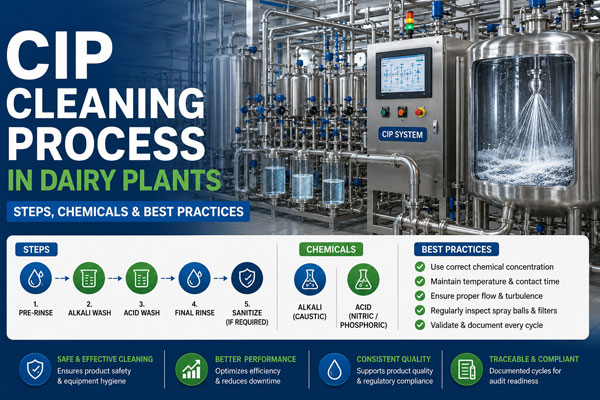
Milk is one of the most complete foods, but it is also highly delicate. In every milk processing plant, raw milk leaves behind residues like milk fat, proteins, lactose, and minerals on inner equipment surfaces. If these soils remain inside pipelines or storage tanks, bacteria quickly grow and spoil fresh milk batches. Implementing an effective CIP cleaning process in dairy plants is the most reliable way to remove these residues, control microbial growth, and protect the taste, safety, and shelf life of your dairy products.
Poor sanitation leads to serious operational issues. Uncleaned surfaces cause off-flavors, high bacterial counts, reduced heat-transfer efficiency in pasteurizers, and expensive batch losses. Furthermore, dismantling complex processing equipment for hand scrubbing wastes labor hours and causes unnecessary machinery wear. Modern dairy plants rely on structured cleaning programs to maintain high hygiene standards while keeping production lines running efficiently.
This comprehensive guide breaks down the complete Clean-in-Place cycle for small, medium, and large dairy units. You will learn how different cleaning stages work, how to select specialized dairy plant cleaning chemicals, how water quality affects wash results, and how to troubleshoot common cleaning failures.
Clean-in-Place, widely known as CIP, is an automated method used to clean the interior surfaces of pipes, vessels, process equipment, filters, and fittings without dismantling the machinery. In the dairy industry, CIP cleaning in dairy industry operations involves circulating liquid cleaning solutions through the exact pathways that milk travels during processing.
By pumping water, detergent solutions, and sanitizing agents through closed circuits at controlled velocities, temperatures, and times, dairy plants clean their equipment thoroughly. CIP systems are essential for:
Understanding Cleaning, Disinfection, and Sterilization
It is vital for dairy plant teams to understand that cleaning and sanitizing are separate processes:
Sterilization: The complete destruction of all living microorganisms, including bacterial spores. CIP processes in standard fluid milk plants aim for thorough cleaning and effective sanitization, rather than medical-grade sterilization.
The dairy CIP cleaning process plays a direct role in maintaining food safety, operational efficiency, and regulatory compliance. Milk ingredients react differently when exposed to heat and processing surfaces, creating complex layers of contamination:
Signs of an Ineffective CIP Cycle
If your automated CIP routine is failing, your facility will show clear warning signs:
| Dairy Soil | Where It Occurs | Why It Is Difficult to Remove | Suitable Cleaning Approach |
|---|---|---|---|
| Milk Fat | Raw milk lines, storage tanks, butter churns, filling nozzles | Repels water; creates an oily film that traps bacteria underneath. | Warm circulation of an Alkaline Cleaner for Dairy with emulsifying surfactants. |
| Protein (Baked-on) | Pasteurizer heat exchangers, evaporators, UHT tubes | Heat denatures proteins, binding them tightly to stainless steel surfaces. | High-temperature heavy-duty caustic soda or boosted alkaline wash. |
| Lactose Residue | Evaporators, whey drying lines, cheese vats | Caramels and burns under high heat, forming sticky brown layers. | Hot alkaline wash combined with active chelating agents. |
| Mineral Scale (Milkstone) | Heated surfaces, hot water lines, pasteurizer hold tubes | Insoluble in plain water; forms hard white layers of calcium phosphate. | Warm acid cleaning stage using nitric or phosphoric acid blends. |
| Biofilm Risk | Dead legs in piping, worn gaskets, aged spray balls | Bacteria build a protective slime layer that shields them from mild cleaners. | Thorough alkaline cleaning followed by a dedicated peracetic acid disinfectant. |
| Mixed Deposits | Cheese processing vats, yogurt fermenters, aging tanks | Contains fats, complex proteins, and lactic acid minerals bound together. | Two-stage cleaning: Heavy alkaline wash followed by an acid wash cycle. |
Achieving clean equipment requires using specialized Dairy Plant Cleaning Chemicals. Standard non-dairy detergents fail to remove tough milk fats and protein complexes
Key Chemical Categories
| Chemical Type | Main Function | Common Application | Selection Consideration |
|---|---|---|---|
| Alkaline Cleaner | Removes fat and protein layers | Milk lines, storage tanks, pasteurizers | Must be low-foaming at high pumping speeds |
| Caustic Additive | Boosts caustic cleaning power | High-heat processing equipment | Must match water hardness levels |
| Acid Cleaner | Dissolves milkstone & rust | Pasteurizers, evaporators, hot circuits | Must be non-corrosive to equipment alloys |
| Surfactant Booster | Improves fat emulsification | Cream processing lines, butter units | Needs rapid rinsability to avoid residue |
| Sanitizer / Disinfectant | Destroys bacteria & spores | Cold-milk lines, filling lines | Must be food-safe with low odor |
| Water Conditioner | Prevents hard water precipitation | Pre-rinse and final rinse circuits | Selected based on local water hardness |
Every successful Milk Processing Plant Cleaning routine depends on four interconnected variables, known as Sinner’s Circle (TACT):
If you reduce one factor, you must increase one or more of the remaining three to achieve the same level of cleanliness.
| Cleaning Factor | Impact When Factor Is Too Low | Impact When Factor Is Too High |
|---|---|---|
| Time | Incomplete soil removal; lingering fatty film. | Wasted electricity; reduced plant throughput time. |
| Temperature | Fats remain solid; weak protein breakdown. | Proteins bake onto steel; high energy costs. |
| Chemical Action | Soil remains; bacteria survive wash cycle. | Surface corrosion; chemical waste; hard to rinse. |
| Turbulence / Flow | Dead spots remain unwashed; low soil lift. | Excess line pressure; pipe vibration; pump wear. |
Every successful Milk Processing Plant Cleaning routine depends on four interconnected variables, known as Sinner’s Circle (TACT):
If you reduce one factor, you must increase one or more of the remaining three to achieve the same level of cleanliness.
| Cleaning Factor | Impact When Factor Is Too Low | Impact When Factor Is Too High |
|---|---|---|
| Time | Incomplete soil removal; lingering fatty film. | Wasted electricity; reduced plant throughput time. |
| Temperature | Fats remain solid; weak protein breakdown. | Proteins bake onto steel; high energy costs. |
| Chemical Action | Soil remains; bacteria survive wash cycle. | Surface corrosion; chemical waste; hard to rinse. |
| Turbulence / Flow | Dead spots remain unwashed; low soil lift. | Excess line pressure; pipe vibration; pump wear. |
Water makes up over 95% of a CIP wash solution. Unconditioned water directly impacts your plant’s sanitation success and overall operating costs.
Managing Water Quality
Dairy plants in industrial hubs like Ahmedabad and across Gujarat should perform water quality testing every quarter. If your water hardness exceeds 100 ppm ($CaCO_3$ equivalent), install an industrial water softener or select specialized dairy cleaners containing built-in sequestering agents.
Verification confirms that your sanitation routine works consistently day after day. Quality control teams must combine immediate physical checks with ongoing laboratory testing.
Important Note: All hygiene testing, titration checks, and swab procedures must be performed by trained QA/QC personnel following standard operating procedures (SOPs).
A well-designed CIP cleaning process in dairy plants is the foundation of high-quality milk processing. By understanding how alkaline and acid cleaners remove fat, protein, and mineral deposits, dairy plant managers can protect product flavor, extend shelf life, and maintain peak equipment efficiency.
Cleaning success depends on balancing the four key factors—Time, Temperature, Chemical concentration, and Mechanical flow—while monitoring local water quality and following strict verification steps. Whether you manage a small regional milk collection center or a large automated processing unit, investing in structured cleaning protocols keeps your production lines safe, compliant, and productive.
Take the Next Step in Dairy Hygiene
Optimizing your CIP cycle starts with selecting the right chemical formulations for your water and equipment setup. Aahan Chemical manufactures high-performance dairy cleaning chemicals, alkaline cleaners, caustic additives, acid wash solutions, and specialized disinfectants for milk processing units in Ahmedabad, across Gujarat, and throughout India.
Contact our dairy hygiene specialists today to request customized chemical selection guidance, technical data sheets, on-site cleaning trial support, or a competitive supply quotation for your plant.
The CIP cleaning process in dairy plants is an automated method for cleaning internal surfaces of pipes, tanks, pasteurizers, and filling equipment without dismantling them. Cleaning solutions, warm water, and sanitizers are circulated through closed circuits to remove milk fats, proteins, and minerals safely and efficiently.
A standard dairy CIP routine includes nine core stages: product recovery, warm pre-rinse, alkaline cleaning wash, intermediate water rinse, acid cleaning (when mineral scale is present), final potable water rinse, sanitization or disinfection, inspection/verification, and safe line release for processing.
Dairy CIP systems use specialized industrial cleaning chemicals, including alkaline cleaners (sodium or potassium hydroxide blends) to remove fats and proteins, acid cleaners (nitric and phosphoric acid blends) to dissolve mineral scale, low-foam surfactants, and no-rinse disinfectants like peracetic acid (PAA).
An Alkaline Cleaner for Dairy equipment is essential for dissolving organic soil loads. High pH alkaline solutions break down tough milk proteins through hydrolysis and turn insoluble milk fats into water-soluble soap compounds through saponification, allowing organic soils to wash away easily.
Not always. Cold-milk pipelines and raw storage tanks may only require acid washing periodically (such as 1 to 3 times per week) depending on water hardness. However, heated processing circuits like pasteurizer heat exchangers require acid cleaning every cycle to remove baked-on milkstone deposits.
Cleaning is the physical and chemical removal of visible soils, fats, and protein films from equipment surfaces. Sanitizing comes after cleaning and uses approved chemical agents or heat to destroy remaining microscopic bacteria. Equipment must be visually clean before sanitizers can work effectively.
Dairy quality teams verify CIP cleaning using visual inspections through vessel manways, inline conductivity meters, pH testing of final rinse water to confirm chemical removal, temperature and flow data logs, rapid ATP bioluminescence swabs, and laboratory microbiological culture tests.
Excess foam usually results from using general-purpose manual detergents instead of low-foam CIP formulations. It can also be caused by air drawing into return pumps through damaged pipe gaskets, running pumps at incorrect speeds, or reaction with high fat loads under poor flow conditions.
Hard water contains high calcium and magnesium levels that neutralize active alkaline ingredients, reduce detergent efficiency, cause mineral scale to build up on heating surfaces, and alter inline conductivity sensor readings. Hard water regions require water softeners or cleaners fortified with sequestering agents.
Dairy equipment must be cleaned at the end of every production run or processing shift. Continuous milk processing lines, such as pasteurizers, are typically shut down for a full CIP wash every 8 to 20 hours of continuous operation to prevent excessive protein burn-on and microbial growth.