
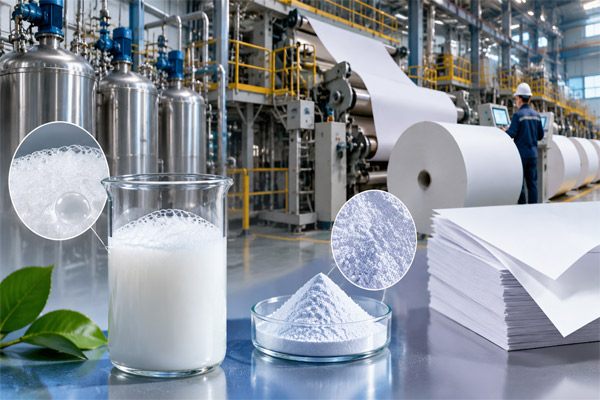
Paper mills face two persistent production challenges: foam that disrupts processing efficiency, and whiteness expectations that raw fibers cannot meet alone.
Foam formation causes lost production time, quality defects, wastewater problems and operational stress. An optical brightening agent alone cannot solve this problem—you need a defoamer for paper industry that works at your specific process stage.
Similarly, even the brightest virgin fibers cannot achieve the visual whiteness that printing papers, packaging boards and tissue grades demand. An optical brightening agent fills this gap, adding optical whiteness that improves customer perception and product value.
This guide explains how paper mills choose the right silicone defoamer, understand anti-foaming chemistry, and select the correct optical brightening agent for their production targets. Whether you operate a large integrated mill or a tissue converter, these two chemicals are essential to quality and efficiency.
A defoamer for paper industry is a chemical compound that breaks down or prevents foam formation at multiple production stages. Foam is not simply air bubbles—it’s a complex structure that traps air inside thin liquid films. Defoamers collapse these films by reducing surface tension, causing bubbles to merge and escape.
Foam forms when mechanical action, chemical reactions, or air entrapment occur during:
Each stage produces foam with different characteristics, which affects defoamer selection.
A silicone defoamer is one category of anti-foaming agent. Unlike traditional organic defoamers, silicone-based products work through a different mechanism:
They do not dissolve in the aqueous paper slurry. Instead, they float on foam surfaces and puncture bubble films by disrupting the interfacial tension that holds foam bubbles together. This causes rapid foam collapse.
Silicone defoamers are fast-acting and effective across a wide pH range, making them suitable for alkaline and neutral papermaking processes. They are also thermally stable, meaning they remain effective at higher paper machine temperatures.
Defoamers are added at multiple points:
Different process stages may require different defoamer types or concentrations.
An optical brightening agent (OBA) is a chemical that increases the apparent whiteness and brightness of paper by absorbing ultraviolet (UV) light and re-emitting it as visible blue light. This optical effect makes paper appear brighter than the raw fiber color alone can achieve.
How Optical Brightening Works
Optical brightening agents are not bleaching chemicals. They do not chemically alter fiber or remove color. Instead, they work through optical principles:
When paper is viewed under normal or fluorescent light, OBAs absorb invisible UV rays and convert them to visible blue light. This blue light masks any yellow or dull tones in the paper, making it appear whiter and brighter to the human eye. The effect is immediate and proportional to the amount of optical brightening agent applied.
Processing Stage for Optical Brightening Agent Application
Optical brightening agents are added at the wet-end, during the approach to the forming section, or in the pulp slurry before sheet formation. They become part of the finished paper structure and remain effective throughout the paper’s life.
Some mills also apply optical brightening agents during coating operations for certain grades. Always follow the supplier’s recommended application method for your specific product.
Benefits of Optical Brightening Agents
Selection Criteria for Optical Brightening Agents
When choosing an optical brightening agent supplier, evaluate:
Step 1: Understand Your Foam Challenge
Where does foam form in your process?
What is the severity?
Step 2: Define Your Brightness Target
What ISO brightness level do your customers require?
Different paper grades have different targets:
Your optical brightening agent dose should be calculated to reach this target. Start with trial samples and adjust based on testing.
Step 3: Match Products to Your Process Parameters
Step 4: Source from a Reliable Paper Chemicals Manufacturer
A reputable paper chemicals manufacturer in India should provide:
| Feature | Defoamer (Silicone) | Optical Brightening Agent |
|---|---|---|
| Primary Purpose | Breaks down foam, prevents bubble formation | Increases apparent whiteness and brightness |
| Application Stage | Multiple stages (pulping, wet-end, size press, waste streams) | Wet-end, pulp slurry, sometimes coating stage |
| Process Impact | Improves drainage, reduces downtime, speeds production | Enhances visual appearance, meets brightness specifications |
| Chemical Type | Silicone polymer or organic compound | Organic aromatic compound with UV-absorbing groups |
| Mechanism | Disrupts bubble film tension and causes foam collapse | Absorbs UV light and emits visible blue light |
| Affects Paper Strength? | No, only controls foam formation | No, optical effect only and does not alter fiber |
| Selection Factor | Paper grade, pH, furnish, foam severity, temperature | Paper grade, brightness target, furnish type, light fastness |
| Interaction with Other Chemicals | May interfere with coatings if the wrong type is selected | Must not react with sizing or retention aids |
| Expected Benefit | Faster sheet formation, reduced drainage time, cleaner process | Brighter finished paper, customer satisfaction, premium pricing |
| When Both Are Needed | Yes — Defoamers solve production issues, while OBA improves paper appearance and brightness. | |
Always work with established paper defoamer suppliers in India that offer:
Based in Ahmedabad, Gujarat, Aahan Chemiex LLP is an established paper chemicals manufacturer in India serving integrated mills, tissue converters, packaging mills and specialty paper producers across India.
As a silicone defoamer manufacturer in India, we understand the specific challenges of Indian papermaking:
We also supply optical brightening agents, paper sizing chemicals, and other paper processing chemicals as a complete paper chemicals solution.
When you buy silicone defoamer in bulk, you’re sourcing from a manufacturer with local expertise and nationwide delivery capability.
You may need to switch chemicals in these situations:
Always request trial samples before switching to a new product. Small chemical changes can have large effects on paper quality and machine performance.
Defoamers and antifoaming agents are used interchangeably. Antifoaming agents are added to prevent foam from forming initially, while defoamers break down existing foam. In practice, most chemicals perform both functions. The best anti foaming agent manufacturer makes products optimized for your specific paper grade and process stage.
Optical brightening agents only create the appearance of whiteness—they don’t actually bleach fiber or remove color. If your furnish has high dirt content, colored contamination, or inherently dark pulp, an OBA alone won’t achieve extreme brightness targets. You may need improved pulping, bleaching, or furnish upgrades alongside optical brightening.
No. Silicone defoamers and most organic defoamers only control foam; they do not affect fiber strength or bonding. However, if the wrong defoamer type is chosen and it interferes with sizing or other additives, indirect strength effects can occur. This is why working with an experienced defoamer supplier is important.
Not necessarily. Tissue and coated papers have different brightness targets, retention requirements, and coating sensitivities. Some optical brightening agents are optimized for tissue; others for printing paper. Check with your optical brightening agent supplier about suitability for each grade.
Recycled fiber furnish tends to foam more than virgin pulp and may have lower baseline brightness. You may need a stronger defoamer for recycled operations and higher doses of optical brightening agent. Ink residues and old coatings also affect both chemical performance. Always test with your exact furnish composition.
This depends on where foam forms in your process. Defoamers added at the machine chest control foam at the sheet-forming stage. Defoamers in white water loops control foam in recycled streams. Your supplier can recommend the optimal injection point based on your specific foam challenge.
Optical brightening agents primarily add blue light, which makes paper appear whiter but can shift perceived color slightly toward blue. If your customers judge color carefully (for example, tissue tones or creative printing papers), you may need to adjust your dye dosage after adding an OBA. Consult your supplier about color matching.
Check the technical data sheet for each product. Some combinations are compatible; others are not. Silicone defoamers and aqueous optical brightening agents should generally be stored separately to prevent separation or stability issues. Keep all chemicals in cool, dry storage away from direct sunlight.
Too much defoamer can leave residue in the paper, potentially affecting coating properties, printability, or finish. Over-dosing is wasteful and expensive. It may also affect felt life or drying performance. Always follow your supplier’s recommended dose range and avoid the temptation to “add more” if foam persists—instead, investigate the root cause.
Optical brightening agents are relatively light-stable if the finished paper is stored indoors away from direct sunlight. In bright sunlight or under intense fluorescent light, some optical brightening agents may gradually fade over months or years. Choose an OBA with good light fastness if your paper will be exposed to bright conditions during end-use.