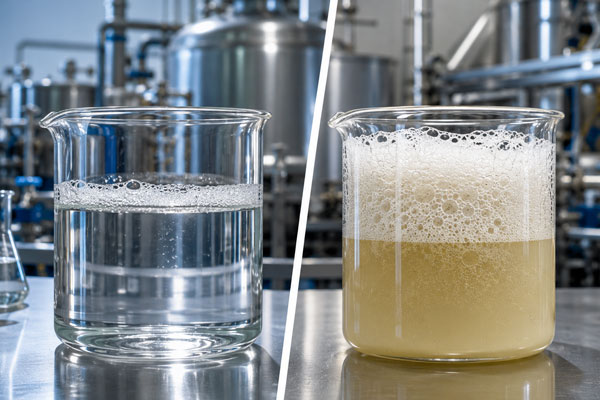
Foam is a major headache in many manufacturing plants. When liquids are mixed rapidly, pumped, or treated with chemicals, trapped air creates thousands of tiny bubbles. If you do not control this foam, it can slow down your entire production line. That is why understanding the difference between Silicone Defoamer vs Non Silicone Defoamer is so important for plant managers and industrial buyers.
Choosing the wrong defoaming agent can lead to serious problems. It might cause uneven coatings, ruin fabric printing, or create messy overflows that waste time and money. Every industrial process requires a specific solution depending on the chemicals used, the operating temperature, and the final product quality expected.
In this complete guide, we will cover everything you need to know. We will explain how both types work, their main advantages, and their limitations. You will also find a detailed comparison to help you choose the right foam control chemical for your specific textile, paper, or industrial processing needs.
Foam is simply a mass of gas bubbles trapped in a liquid. In industrial processes, water is often mixed with surfactants. Surfactants are chemicals like soaps, detergents, and wetting agents that reduce the surface tension of water. When you combine these chemicals with mechanical actions—such as fast mixing, heavy pumping, or spraying—air gets trapped. This trapped air creates a stable foam that does not pop on its own.
Foam causes massive problems in manufacturing. It takes up valuable space in tanks, leading to inaccurate volume readings. If the foam spills over, it causes messy and dangerous overflows. It also slows down production because operators have to wait for the foam to settle before adding more liquid. Furthermore, trapped air bubbles can cause uneven coatings, leaving surface defects on the final product.
Here are common signs that your plant has a foam-control problem:
A silicone defoamer is a highly effective chemical additive designed to destroy existing foam and prevent new foam from forming. It is primarily made from silicone oils mixed with microscopic particles of silica.
To understand its basic working principle, imagine a balloon floating on water. The silicone defoamer acts like a tiny needle. Because silicone does not mix easily with water, it spreads very quickly across the surface of the foam. It enters the thin wall of the bubble, weakens it, and causes the bubble to pop instantly.
In general terms, a silicone-based defoamer contains three main components. First is the active silicone oil (often called PDMS), which does the heavy lifting. Second is a hydrophobic (water-repelling) solid like silica, which helps pierce the bubbles. Third are emulsifiers, which help the silicone mix gently into your water-based system without separating.
Common industrial applications for silicone defoamers include high-temperature textile dyeing, heavy-duty industrial cleaning, wastewater treatment, and chemical manufacturing. They are chosen whenever a heavy-duty, fast-acting industrial defoamer is required.
Silicone defoamers are popular because they are incredibly powerful. However, their unique chemistry means they are not perfect for every single application.
Advantages:
Limitations:
A non silicone defoamer is an antifoaming agent that contains absolutely zero silicone. Instead of silicone oils, these defoamers are made from other raw materials like mineral oils, vegetable oils, waxes, fatty alcohols, or special polymers.
Non silicone defoamers control foam in a similar way to silicone types. They spread across the surface and break the bubble walls. However, because they use different base materials, they do not leave behind the stubborn, water-repelling residues that silicone does.
These products are generally classified by their base system. Oil-based defoamers use mineral or natural oils to break foam. Water-based defoamers often use long-chain fatty alcohols suspended in water. Polymer-based defoamers use advanced synthetic molecules to control foam without oils.
Applications that require silicone-free processing rely heavily on non silicone antifoams. This includes paper coating, textile printing, paint manufacturing, and adhesive production. In these industries, even a tiny drop of silicone could ruin the final product.
They blend very well into many different chemical formulations.
They are highly recommended for surface-sensitive applications like coating, printing, and painting.
Because they do not contain stubborn silicone, they rinse out easily during washing stages.
They completely eliminate the risk of dark, oily silicone spots on fabrics and paper.
You may need to use a slightly higher dosage to get the same foam knockdown as a silicone defoamer.
Some non silicone types may break down or lose effectiveness at extremely high boiling temperatures.
They might take a few moments longer to collapse heavy, dense foam.
They may not keep foam away for as long in continuous processes.
Before choosing a foam control chemical for your facility, you must compare how these two options perform in daily operations. Here is a detailed Silicone Defoamer vs Non Silicone Defoamer comparison to guide your decision.
| Comparison Factor | Silicone Defoamer | Non Silicone Defoamer | Why the Difference Matters |
|---|---|---|---|
| Foam knockdown | Very fast and aggressive | Moderate to fast | Crucial when an overflowing tank needs an instant fix. |
| Long-term foam control | Excellent (prevents foam for a long time) | Moderate (may need re-dosing) | Continuous processes prefer long-term control to save labor. |
| Typical dosage tendency | Very low | Moderate to slightly higher | A higher dosage requirement affects your bulk purchasing volume. |
| Surface compatibility | Poor (can repel water/dye) | Excellent | Determines if the product can be painted, dyed, or printed evenly. |
| Printing and coating concerns | High risk of “fish eyes” and bare spots | Very safe; zero silicone spots | Essential for high-quality paper, paint, and textile finishes. |
| Temperature stability | Extremely stable at high heat | Can lose efficiency at high heat | Important for high-temperature dyeing and hot washing processes. |
| Ease of dispersion | Requires good mixing/agitation | Generally easier to mix in | Affects how easily the chemical can be added to your tanks. |
| Residue risk | High (stubborn silicone deposits) | Low (washes out easily) | Prevents buildup on machinery, pipes, and heating elements. |
| Cost-in-use | Lower cost-in-use due to low dosage | May have higher cost-in-use | Affects the overall operational budget of the factory. |
| Wastewater considerations | Harder to break down biologically | Generally more biodegradable | Important for meeting local environmental and effluent standards. |
| Textile applications | Jet dyeing, scouring, effluent treatment | Printing, sensitive finishing, light washing | Dictates fabric quality and reject rates in a textile mill. |
| Paper applications | Kraft pulping, wastewater | Paper machine sizing, surface coating | Prevents paper tearing and coating defects on the paper machine. |
| Cleaning applications | Heavy industrial floor cleaners | Mild detergents, sensitive surface cleaners | Ensures cleaning products do not leave oily streaks behind. |
| Suitable production conditions | High agitation, high temp, heavy foam | Low-to-medium shear, temperature-sensitive | Matches the chemical to your exact plant machinery. |
The textile industry uses large amounts of water and surfactants. Foam problems occur at almost every stage, including pretreatment (desizing and scouring), dyeing, washing, and finishing.
In high-speed Jet dyeing machines, the fabric moves rapidly through hot, soapy water. This creates massive turbulence and heavy foam. Here, a Silicone Defoamer is usually the best choice because it withstands boiling temperatures and strong pressure. However, when it comes time to print patterns on the fabric, silicone is strictly avoided. Silicone repels the printing paste, leaving unprinted dots on the fabric. Therefore, a Non Silicone Defoamer is mandatory in the printing department.
Fabric type, bath composition, temperature, and final finishing requirements all dictate your choice. Use this quick textile-selection checklist:
Selecting the best defoamer is a logical process. Follow this numbered guide to make the right choice:
Ultimately, deciding on a Silicone Defoamer vs Non Silicone Defoamer comes down to balancing raw power with product safety.
Silicone defoamers should be considered when you need aggressive, fast, and high-temperature foam control, and when the final product is not sensitive to surface defects. Non silicone defoamers should be considered when you are coating paper, printing textiles, or manufacturing products where silicone spotting is strictly unacceptable. Neither type is universally superior; they are simply tools designed for different jobs.
If you are struggling with foam overflows, uneven coatings, or high chemical costs, it is time to test a better solution. Contact a trusted manufacturer to request product guidance, technical data sheets, or a trial sample to find the perfect foam control chemical for your plant today.
A silicone defoamer uses silicone oils and silica to quickly break foam and withstand high heat. A non silicone defoamer uses mineral oils, waxes, or polymers instead of silicone. Non silicone types are safer for painting, coating, and printing because they do not leave water-repelling spots.
It depends on the specific stage. Jet dyeing machines at high temperatures usually require strong silicone defoamers. However, textile printing and sensitive fabric finishing processes require non silicone defoamers to prevent bare dots and uneven colors on the cloth.
Yes, it can negatively affect printing. Silicone naturally repels water. If silicone residue remains on the fabric, the water-based printing paste will not stick to those areas. This results in unprinted spots and rejected fabric batches.
They are primarily used in industries where surface quality is critical. This includes paper machine coatings, textile screen printing, water-based paint manufacturing, adhesive production, and any other process where silicone would cause “fish eyes” or surface defects.
While a defoaming agent quickly pops existing bubbles (knockdown), it also acts as an antifoam to prevent new bubbles from forming (hold-out). However, complete prevention requires constant dosing and proper mechanical setup in your mixing tanks.
Overdosing does not improve foam control. Instead, it wastes money, causes oily chemical buildup on your machinery, and dramatically increases the risk of spotting on your finished textiles or paper. Always use the minimum effective amount.
There is no fixed formula. You must calculate it through a laboratory trial. Start with a very small amount (as recommended on the supplier’s technical data sheet) in a sample beaker. Slowly increase the amount until the foam is controlled safely.
It is heavily used in early kraft pulping and wastewater treatment due to severe foam. However, it is not suitable for paper sizing or coating stages, as silicone deposits will cause weak paper spots and severe coating defects.
A plant trial proves how the chemical reacts with your specific water, temperature, and surfactants. It ensures the chemical controls the foam efficiently without causing negative side effects to your machinery or your final product quality.
It should be stored in a cool, dry place away from direct sunlight and freezing temperatures. Keep the drums or IBC totes tightly sealed to prevent contamination and separation. Always stir the product gently before use if it has been stored for months.